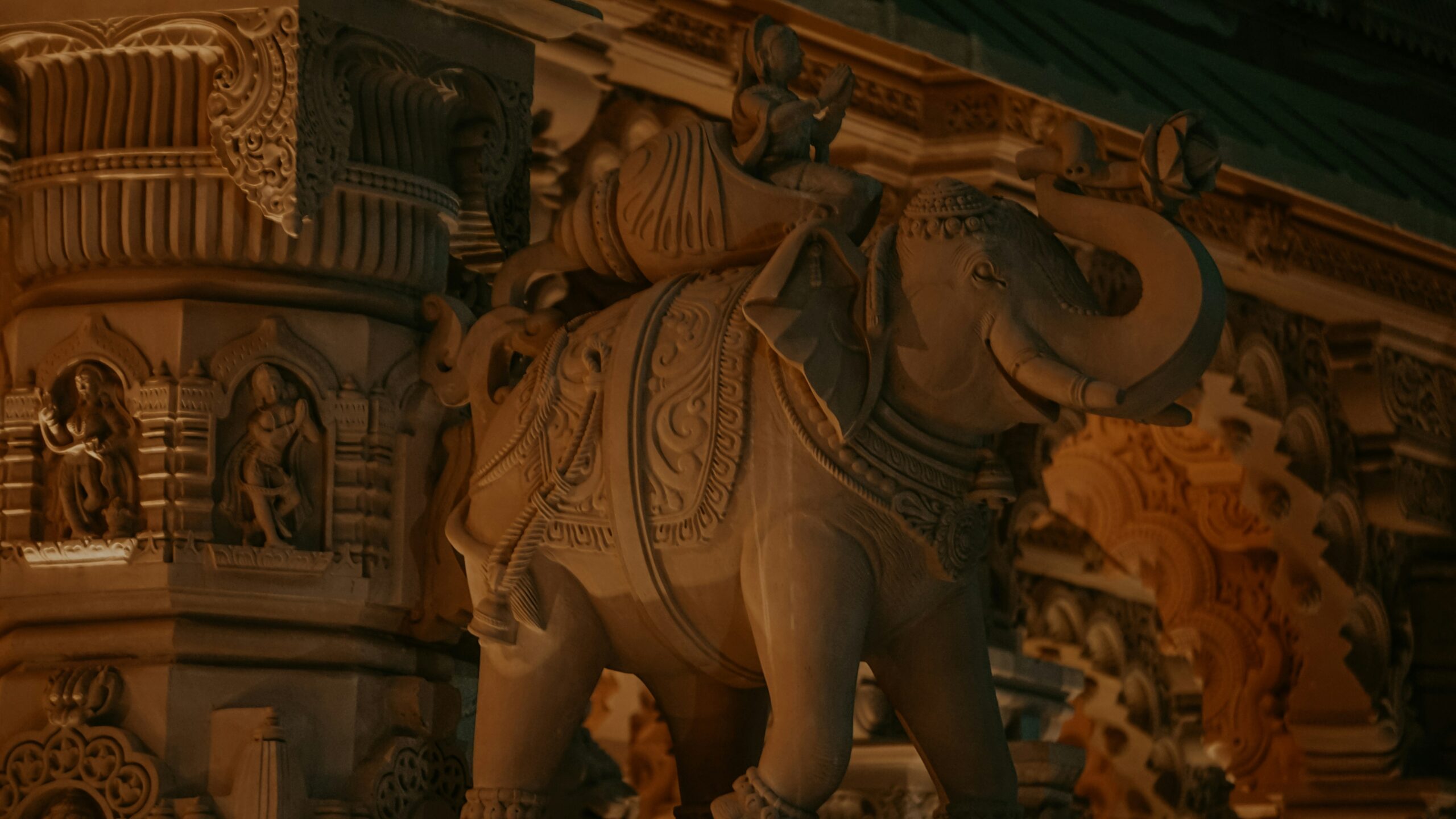
बृहस्पति ग्रह
Guru — गुरु — has become an easy label for any guide, expert, or voice of confidence but Sanskrit does not create single-purpose words. Beneath its familiar surface lies a duality that its casual use barely grazes. Guru houses two syllables, gu — that which obscures — and ru — that which removes obscuration. In the Upanishadic imagination, a guru is not someone who pours knowledge into you but someone who removes what prevents your own knowing from rising.
The word stretches beyond a human figure to means a principle, a quality, or even a pull toward truth. In Jyotish it is Jupiter — the planet whose intelligence expands rather than overwhelms.
Guru in Jyotish
In Jyotish, Jupiter is called Guru not because it is large, but because it is vast — a distinction Sanskrit makes with astonishing clarity. “Large” is a measurement. “Vast” is a condition of consciousness.
Guru is believed to embody Mahadivya-jnana, a field of infinite intelligence that expands without unravelling.
Among the Navagrahas, where Venus (Shukra) whispers pleasure, Guru inspires purpose; where Mercury (Budh) offers intellect, Guru brings insight, and where Mars (Mangal) urges action, Guru asks: “To what end?”
Guru governs sattva, the clarity that allows things to be seen as they are. In a universe that loves drama and duality, Guru is a steady voice that says: “Slow down. Look again.”
Sagittarius and Pisces are the two signs in Jyotish that are believed to be most influenced by Guru. They also fittingly reveal its two polarities: the quest and the quiet. The seeker who travels outward in search of truth and the mystic who dissolves within toward it.
Placement: where the inner teacher lives
In a birthchart, Guru’s placement shows where the real teacher in your life lives — not necessarily a person, but a pattern of wisdom and expansion.
A well-placed Guru gives rise to intuitive guidance, fortune, and a worldview that feels generous and compassionate rather than forced and imposed. Yet its duality is unmistakable: when Guru weakens, wisdom can harden into dogma, expansion into excess, and faith into overreach. One may cling to the idea of truth more tightly than truth itself.
And still, Jyotish reminds us that nothing is entirely auspicious or inauspicious. Exalted Jupiter can produce complacency; debilitated Jupiter can sharpen clarity. Context shapes everything. Guru teaches through contrast as much as through classic mentoring.
The essence of guru
Guru’s real power lies in its quiet impact. It shows up in seemingly ordinary moments through a sudden realisation, a feeling of alignment, or a person who offers the right guidance at the right time.
Guru reminds us that abundance is not about having more — it’s about knowing when it is enough. It teaches that the true purpose of knowledge is not in the knowing and sharing but in deepening our compassion and humility.
Understanding where Guru sits in your chart is less about predicting fortune and more about tracing where you are being led to grow, soften, expand, and elevate.
If you’d like to explore where Guru sits in your own chart and what it means for your path, visit yuti.ai.
Associated colour: Yellow and Orange.