
Description (वर्णन) of Varna (वर्ण)

As the discussion was peaking, BAM! I was slammed with the ‘caste system’ argument. I always loose this one because I get too in my head about it. The trouble is real though because most of the things people say when defending something controversial either ends up sounding too desperate, too apologetic, or too fascist. Of course, some get it right and they get to drop the mic.
I was not there yet and just like that I had missed yet another opportune moment to say something impactful. The routine was getting old. So, I did what anybody in my place would have done to think afresh. I moved countries, changed my job, gave myself a new contact number, and a brand new hobby. Joking! Although I did do all those things but entirely coincidentally.
The Ved (वेद)
Anyway, once colonial London was rinsed off me by the free-spirited Amsterdam, I was able to think straight again. So, I decided to go to the source of the problem, The Vedas — ancient Indian books of knowledge. More accurately, The Ved. One would assume this literature to be readily accessible for so many to have an opinion on it. One would be wrong.
Vedic inscrutability
The original manuscript of The Ved, as composed by the original authors, never existed. The Ved were transmitted verbally in Pali through precise memorisation. Pali, an unorganised language, used eleven pathas — techniques that trained speakers to memorise the text, its pronunciation, and its pitch accent perfectly. These methods ensured the transmitters didn’t contaminate the meaning by using a different syntax, since such alternatives simply didn’t exist in an unorganised language like Pali.
The Ved started appearing in written form roughly around 500 BCE in Sanskrit. Sanskrit didn’t replace Pali, it organised it. Sanskrit was born a verb — the act of organising a language by creating rules and structure to standardise it — but somewhere along the way, as ‘organised Pali’ started going by ‘Sanskrit’, it became a proper noun. Anyway, all surviving printed editions are likely copies of copies of copies of copies of…you get the gist. As of today we have innumerable copies in several Indian and non-Indian languages without much guidance on which one is most authentic.
To further complicate matters, The Ved are not just a few books. There are four Ved — Rig, Yajur, Sama, Atharva. Each have their own area of specialisation with knowledge captured as hymns and verses in 10–20 books per Ved. Then every Ved delivers this specialist knowledge in four sub-parts per Ved, namely 1) Samhitas: text on powerful vibrations and sounds, 2) Aranyakas: practical knowledge on how to work with natural elements, 3) Brahmanas: phonology and semantics linked to Samhitas, and 4) Upanishads: philosophy and spiritual explorations. Furthermore, there is a classification between what is heard, sruti, and what is remembered, smriti. This classification alone has resulted in countless smriti and sruti editions over the years.
First mic drop
So, the first hurdle was to identify the specific Ved that prescribed ‘caste system’. The one most quoted by England as the main literature is Manusmriti. This was easy to dismiss conclusively. Firstly, there is exhaustive evidence on its very questionable authenticity. Secondly, it is one of the countless smritis (what is remembered) and not sruti (what is heard), which is considered more authentic in comparison. Lastly, Manusmriti is one of the more recent interpretations of the Ved (only last few centuries), which gained most prominence during the British occupation in India. First mic drop.
Tricky translations
Continued research pointed me towards RigVed as the most probable source of text on ‘caste system’. To start somewhere, I looked for the most recommended translations and that is when the real trouble began. Read one by a western author, Max Muller, and one by an Indian author, Maharishi Dayananda Sarasvati, in hopes of gaining a balanced overview of The Ved by seeing it from two opposing perspectives. While I was expecting small discrepancies, what I found were vast variations. Further reading about my reading revealed that The Ved are tricky to translate.
A lot of the old linguistic connotations are lost to us. So, when we do a literal translation, we get a metaphrase that doesn’t make much sense. This tempts the translator to paraphrase it based on their grasp of the wider context on any Vedic verse. Hence, much like Oobleck, a rigid mind would produce a contrived, one-dimensional meaning; while a fertile mind would deliver a rich, multi-dimensional meaning of the same verse.
Bogged down by all this subjectivity, I decided to refresh my Sanskrit to read the standardised “original” texts of The Ved, easily available online. These texts are probably quite different from the original and have undergone thousands of years of copying. However, the general consensus is that the Sanskrit version preserves a broad sense of what the original authors may have said.
Subjective deciphers
Victory! At least I knew which version to read next, but it wasn’t easy to understand. Apart from the linguistic complexities, the reader has to extract and piece together the meaning like a jigsaw puzzle, otherwise what you get is the notorious half-truth. So to understand the intended meaning of any Vedic verse one has to process all the complexity surrounding the said verse.
What I am trying to say is that anyone can read The Ved but to truly understand its meaning and translate it accurately, one needs to have knowledge of the environment from which it stems.
After numerous night-less days, skipped meals, restless showers, and desperate searches for informed explanations, I found enough evidence to conclude the enclosed.
Varna (वर्ण) system
Here is the verse from RigVed [RV book 10, hymn 90, verse 12] that is cited by western indologists as the source of ‘caste system’.
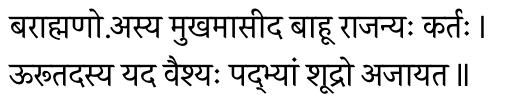
Western translation of the verse in English: At the top of the hierarchy were the Brahmins who were mainly teachers and intellectuals and are believed to have come from Brahma’s head. Then came the Kshatriyas, or the warriors and rulers, supposedly from his arms. The third slot went to the Vaishyas, or the traders, who were created from his thighs. At the bottom of the heap were the Shudras, who came from Brahma’s feet and did all the menial jobs.
The actual closest translation of this verse in English: From this cosmic intelligence comes four most desirable traits of human character — wisdom (Brahmin), nobility (Rajanah), industry (Vaishya) and talent/facility (Shudra).
Further citation from Skanda Purana [Vol. 18, Book VI. Chapter 239, Verse 31–34], additional literature surrounding the above verse:
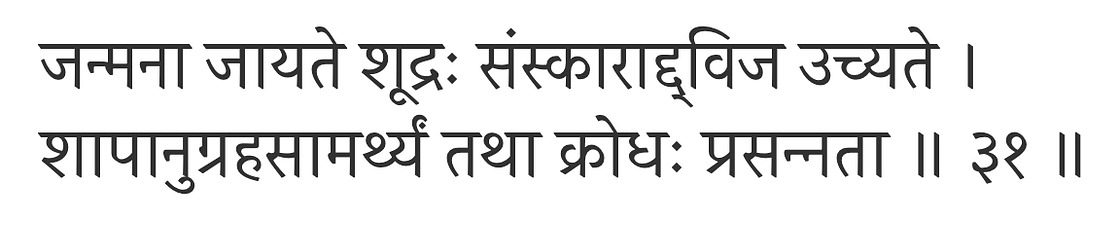
Closest translation in English: Everyone is born Shudra, ie, with some talent or facility. It takes discipline, pain and rigour of years of training (dwija) to qualify as Brahmin for public service.
Brahmins, a.k.a public servants were simply the keepers of Vedic knowledge. They were not born a Brahmin, they were trained to become one. Furthermore, this “system” was not called “caste system”. The word “caste” has its roots in Latin word ‘castus’, which originates from a Portuguese word, ‘casta’, meaning ‘race’. The system mentioned in The Ved was called ‘varna’ (वर्ण), originating from vṛṇoti (वृणोति), meaning “to choose”. The Vedic intention behind the construct was that of choice. Creating your own destiny instead of being victims of one, as is the case in any ‘race’/’caste’ system.
Mic drop.
Some sources worth checking out are, Vedic Heritage portal of the Government of India. Rig Ved book 10. Skanda Purana. A Western translation of RigVed